Four weeks to see what the work between your systems costs you. Everything built after that is measured against it.
A Keelan engagement runs in three parts, each priced in the proposal before work starts. The first, Discovery, ends with a written assessment that is yours to keep whether you continue or not.
- 01DiscoveryA ranked account of where your people’s time goes, and a measure of how the work runs today.Weeks 1-4
- 02BuildThe chosen workflows running across your systems, and a report of what changed.Weeks 5-10
- 03OperateThe layer maintained, the agents tuned, and impact reported each month against where you started.Monthly
The proposal follows a first conversation with both partners. By the end of it they'll tell you whether Keelan can help, and if not, who to contact instead.
hello@keelan.comDiscovery
Discovery is spent where the work happens, with your people and in your systems. At the end you know what that work costs you today and what to build first.
Weeks 1–2
The work and the systems
One partner comes to where the work is done and sits with the people doing it, to see which screens are open, what gets copied from one to another, and where someone keeps a list because no system will. He also asks the people who run the business what they want changed.
In the same two weeks the other partner works through the systems themselves: what each one holds, how to reach it, and where two of them disagree.
Week 3
Checkpoint
The partners bring their findings to the people who run the business, so nothing in the assessment is a surprise. Scope and price can be reopened only here, and only if the systems differ substantially from what the proposal assumed. If so, either side can choose to stop.
Week 4
Assessment
The written assessment ranks six to ten workflows by what each costs you in time and money, how hard it is to build, and how much change it asks of your people. For each, it describes how the work would run afterward and what could stop people from adopting it. It also records how that work performs today, from your own records. That record is the baseline: every later result is measured against it.
At the end of week four, you decide.
If you stop, the engagement ends there. The worst case is that you have paid for Discovery and own a ranked account of where your people’s time goes.
If you go ahead, you choose which of the ranked workflows get built, and each gets a baseline like the example here. It is signed before Build starts, and the final report states what changed against it.
- Workflow
- Month-end close across locations
- what it looks like today
- 12 working days to close the month. 120 staff hours a month re-keying each location’s books into the consolidated ledger.
- Measured from
- Each location’s accounting system, the consolidated ledger, and time with the team that runs the close
- Measured again
- At handover, from the same records, by the same method
- Signed by
- Your controller, before Build starts
What Discovery asks of you
Time with the people who do the work.
One partner sits beside each of them, where they normally work, for a couple of hours. Nothing is staged and the work carries on.
Access to the systems involved.
As they are, and read-only: nothing is changed in your systems during Discovery. Nothing has to be cleaned up or migrated first, and that includes the exports and spreadsheets people keep around them.
One person on your side who can decide.
Someone who can confirm the scope and say yes or no at the end of week four. Each baseline is signed by whoever owns that workflow, and Build does not start without it.
Build
Most of Build is getting your systems to agree: on what a customer is, when a job is complete, and which record wins when two differ. Those decisions sit in one layer under everything you run, and they belong to you.
Agents then do the work between systems, and your people oversee them from screens designed around how they already work. Nothing you already run is replaced: the agents in your platforms stay in place, and Keelan's pick up where each one stops.
Build ends with a measurement: what changed against the baseline, from the same records, by the same method. It is written up for your CFO and your board, and Build does not close until you have signed it. By then your people are trained and the system is documented and monitored.
About ten weeks
from the first Discovery session to handover, for one workflow.
About four months
the same span, for a program of several workflows.
Operate
Your systems will keep changing. Operate keeps the layer and the agents in step with them, reports every month against the baseline, and identifies the next workflow worth building.
It is a monthly retainer, and it is optional: what Build hands over is documented and runs without it. Each workflow after the first costs less, because the layer it runs on is already there.
Selected work, the full account
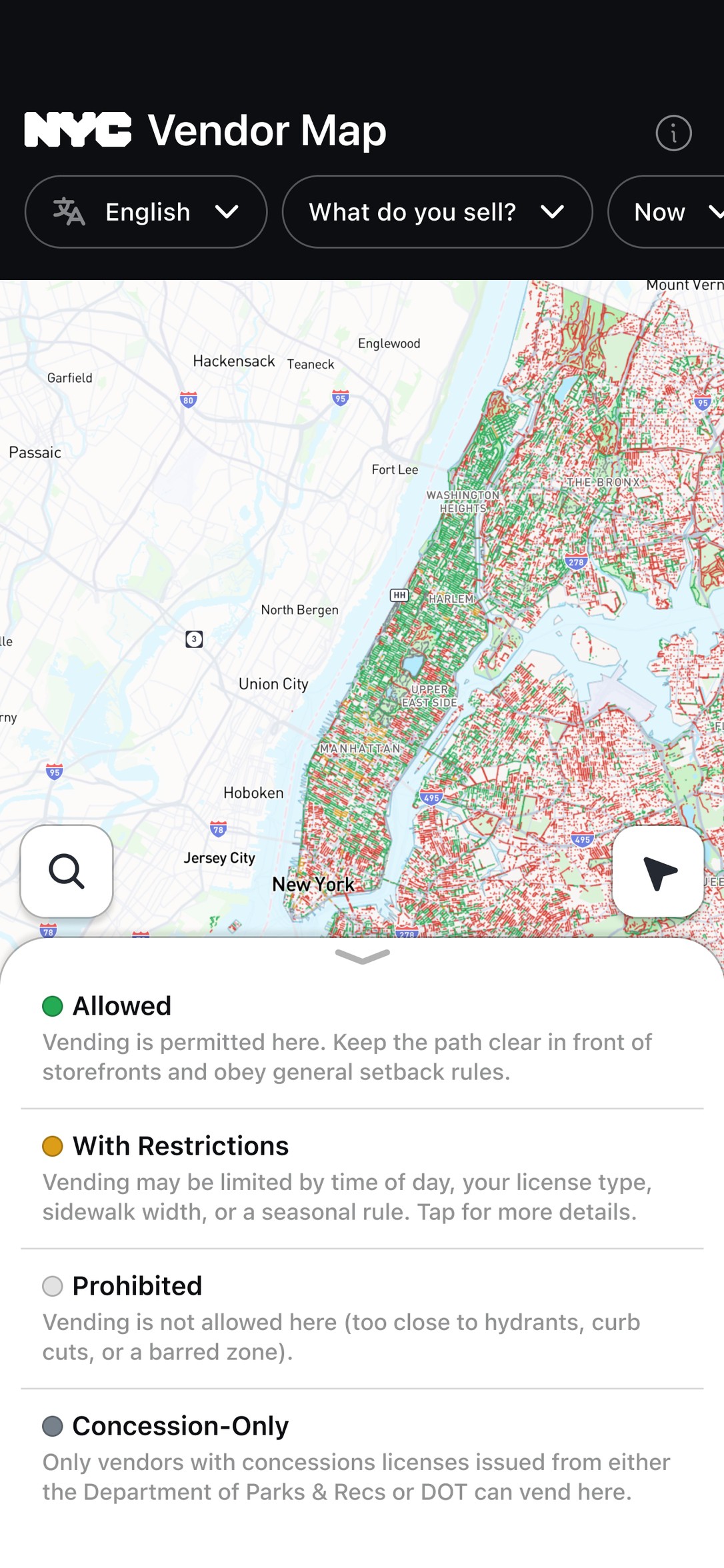
Where can I vend? New York City’s street-vending legal map
Eight agencies whose records were never meant to meet, reconciled into one answer. The same work a company’s systems need, on a harder case.

8
City and State agencies
1
plain-language answer for any spot
The problem
The rules that govern where a New York street vendor may legally stand are spread across eight City and State agencies, in forms that were never meant to meet: map files, a table of restricted streets that exists only as a PDF, vending zones written as prose in the Administrative Code, a map service behind a login, hydrants and subway entrances as bare points. No single map had ever tied them together.
What was built
One layer under the map. Every source is taken from its origin and translated into the same terms: a rule written as words becomes a boundary, a hydrant becomes the keep-clear distance around it. A hydrant from the Fire Department, a zone from the Code and a restricted street from a PDF then resolve, through one fixed order of precedence, into a single plain-language answer for any spot on the sidewalk. The answer changes correctly when the vendor’s license does.
How far to trust it
Every part of the map is marked for how real it is: live data, encoded from statute, a sample standing in, or still awaited. It is always clear which datasets are in hand, which are missing, and what is needed from each department. The known gaps are documented, not hidden.
What it means for a company
This is civic data rather than a company’s operating stack, and a harder case for it: eight agencies that have never shared a schema. In a company, the agencies are the CRM, the billing system, the scheduling tool and the spreadsheet someone keeps, and the question is not where a cart may stand but whether a job has been billed. The work underneath is the same: find the sources, reconcile them, and put something on top that the person using it trusts.
Built by Keelan’s two partners with Live XYZ, for the City of New York. Announced July 2026.
If your people are still carrying work from one system to the next, Keelan would like to hear about it.
hello@keelan.com